

How to Use a Drop-In Self-Watering Planter in a Jar, Bowl, or Water Tray
By Nathan Trowbridge · Mossari
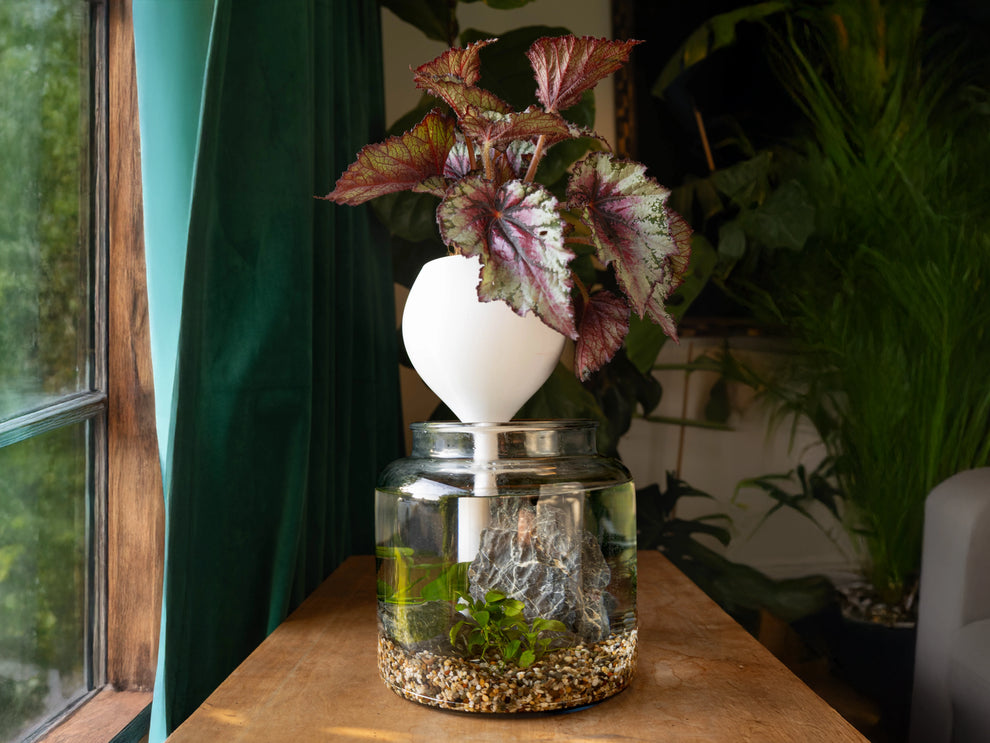
A drop-in wicking planter uses water in a separate vessel to supply a plant growing above it. The Mossari Large Freestanding Wicking Pot has a flat base disc and a wick extending toward the water. You choose the jar, bowl, tray, or custom water display; no aquarium mounting bracket is required.
Listen to this article
3 min 32 sec
What kind of vessel should I use?
Choose a stable, watertight container that accommodates the base and leaves room to inspect and refill the water. Check the planter’s dimensions against the opening and usable interior, not just the vessel’s widest point. A narrow-necked jar may look roomy but prevent access.
The planter must sit securely with its root zone above the water source and its wick reaching the water. Avoid balancing it on an unstable rim or letting the planting chamber sit underwater.
Which plants work in a drop-in wicking pot?
Try a manageable pothos, heartleaf philodendron, Syngonium, peace lily, or moisture-loving fern whose root ball fits the chamber. Match its light and humidity needs to the room. Plants needing a thorough dry-down, including many cacti and succulents, are less suitable for continuous wicking.
Can I leave the plant in its nursery pot?
Here, “drop-in” describes how the Mossari planter sits in your water vessel. Do not assume an unchanged nursery pot will connect correctly to the wick. Plant into the intended growing chamber using an appropriate wicking medium and follow the Mossari setup guidance.
How do I set it up?
- Choose a level location with suitable plant light and a stable vessel.
- Assemble the base and wick as instructed.
- Prepare suitable growing media and add a healthy plant without compacting the mix heavily.
- Add water to the vessel so the wick maintains contact while the growing chamber stays above it.
- Observe media moisture and leaf condition during establishment. Check water contact as the level drops.
Which growing mix should I choose?
The enriched blend adds root-zone nutrition. The inert blend has coco coir, coco chips, and perlite without added fertilizer, letting you manage feeding separately. Plain reservoir water is not a complete nutrient source. A 6-cup bag is listed to fill this large planter; a root ball reduces the amount needed.
Can I use the planter in an aquarium?
The product lists aquariums and jarariums among possible water settings. Keep the assembly stable and accessible, and keep growing mix out of the tank. An aquarium containing animals needs its normal filtration and water-quality care. Do not use ordinary houseplant fertilizer in its water.
How long will the reservoir last?
That depends on the vessel’s usable water capacity, evaporation, plant size, light, temperature, and humidity. A month is not a guaranteed interval for an arbitrary bowl. Check frequently at first and learn your own refill pattern before relying on the setup while traveling.
Why is the plant dry even though the vessel has water?
Check whether the wick actually reaches it, whether the wick contacts the growing medium, and whether the medium is evenly moist. A visible reservoir does not prove the root zone has water. Also reconsider the plant’s size, root establishment, and conditions.
Explore the large drop-in planter and build a water-and-plant display around a vessel you enjoy.