

Can a Self-Watering Planter Keep Houseplants Watered While You Travel?
By Nathan Trowbridge · Mossari
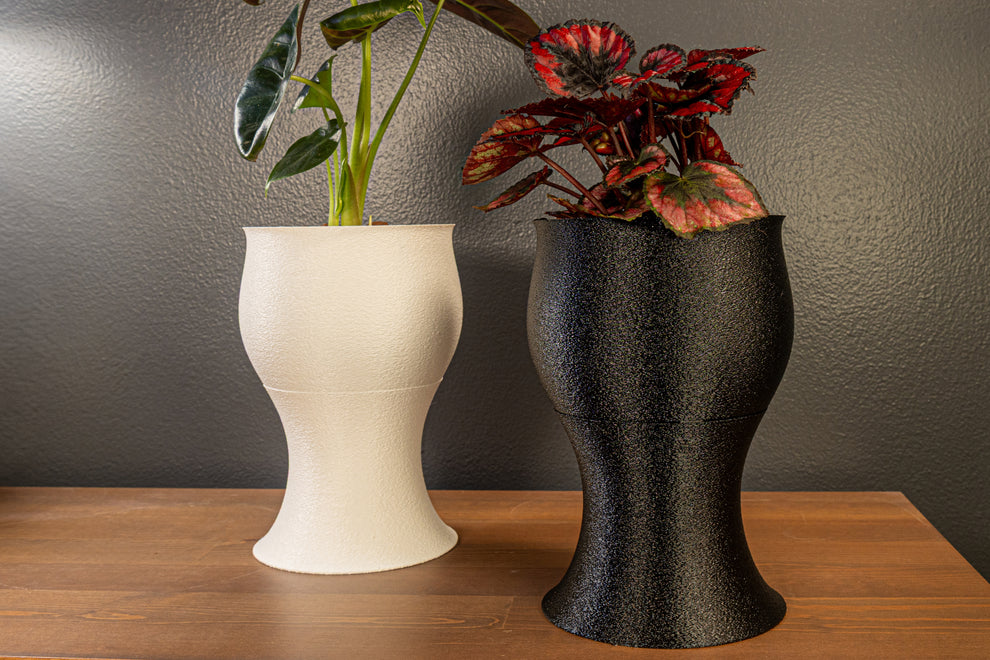
A self-watering planter can extend the time between refills, but it cannot promise the same interval for every plant or home. Test your setup before relying on it during a trip. Mossari’s Nuna, Runae, Oasis, and Soma pair a lower water reservoir with a wick that brings moisture to the growing chamber above.
Listen to this article
3 min 36 sec
They are useful for desks, shelves, and busy routines as well as travel. Their quieter benefit is everyday consistency: less remembering a watering can, and more enjoying the plant.
Which Mossari planter should I choose?
| Planter | Format and planting space |
|---|---|
| Soma | is the compact option for a small plant and tighter desk or shelf space. Its listed substrate coverage is about 3 cups per planter. |
| Oasis | has an hourglass design and a larger integrated reservoir. A 6-cup substrate bag is listed to fill its planting chamber. |
| Nuna | has a tall silhouette with a narrowed waist and softened outline. |
| Runae | offers a rounded, sculptural shape. |
Choose by root-ball fit, available surface space, and the shape you enjoy. Check each product’s current dimensions and options. Do not infer identical capacities or refill intervals from a similar silhouette.
Can I really wait a month between refills?
The product listings describe intervals up to a month, depending on setup. A large thirsty plant in bright, warm conditions can use water faster than a small plant in cooler conditions. Evaporation, humidity, season, and media also affect timing.
Check reservoir level frequently at first and record how long your own setup lasts. Leave a margin before a trip, and arrange someone to check it if your absence exceeds the tested interval. Start the plant well before departure so you can see whether it establishes successfully.
What plants suit these self-watering pots?
Manageable pothos, heartleaf philodendron, Syngonium, Scindapsus, peace lilies, and moisture-loving ferns are candidates when their light and humidity needs are met. Selected tropical begonias may suit an airy mix with observation. Choose a root ball that fits without excessive crowding.
Many cacti and succulents need more drying than a continuously wicking arrangement provides. A pot with water below is still a growing system that must match the plant.
How should I set up and refill the planter?
- Follow the Mossari setup guidance and arrange the wick correctly.
- Prepare a wicking-friendly medium and add a healthy plant.
- Fill the lower reservoir as instructed, with the growing chamber in its intended position above it.
- Check root-zone moisture during establishment.
- Refill by accessing the lower reservoir. Check that the wick remains connected when reassembling.
Which substrate should I choose?
The inert blend contains no added fertilizer and lets you manage nutrition separately. The enriched blend provides additional root-zone nutrition. Both are designed for wicking, but neither means feeding can be ignored forever. See the inert versus enriched substrate guide.
Can a self-watering pot overwater a plant?
Yes, a poorly matched plant, dense medium, incorrect water level, or impaired airflow can leave roots too wet. Passive wicking provides water access; it does not guarantee ideal moisture for every species. If leaves decline while the root zone stays saturated, reassess the setup rather than topping up automatically.
Why does my office plant still look unhappy?
Water is only one need. Check light at leaf level, drafts, temperature, root space, and nutrition. An interior desk far from a window may need a suitable grow light. A reservoir cannot compensate for insufficient light.
Choose the planter that fits your plant and room, then learn its refill rhythm at home. A well-observed setup makes everyday care and time away easier to plan.